
The Gap Between Using AI and Having AI Workflows
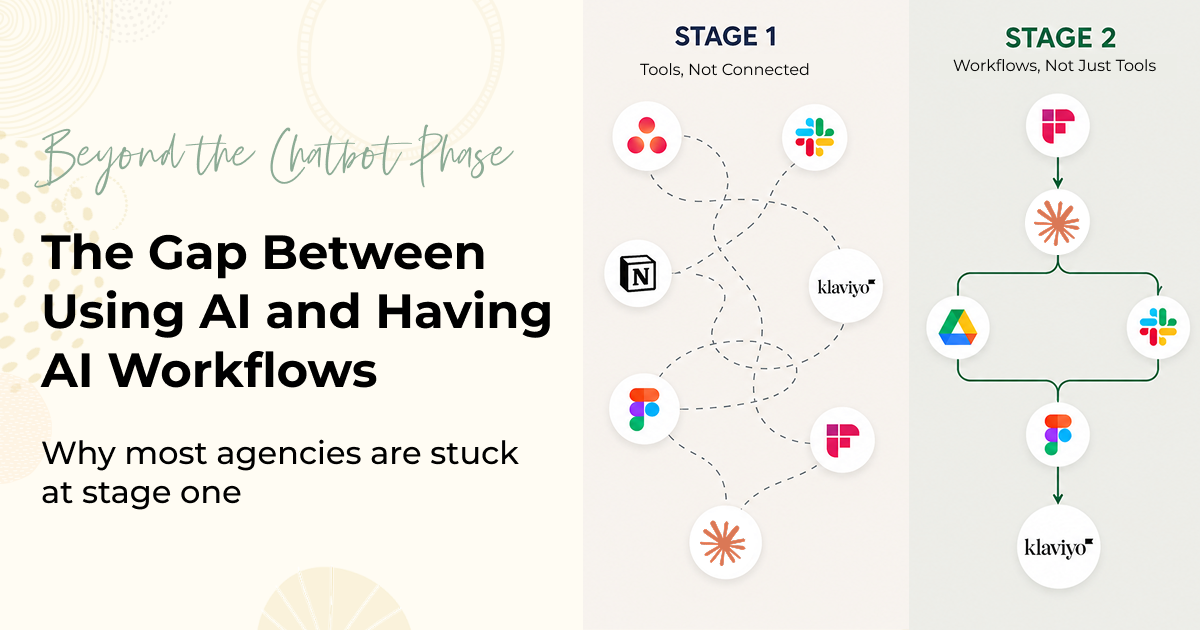
Everyone’s using AI now. Your copywriter uses ChatGPT. Your strategist asks Claude for campaign ideas. Maybe you’ve even connected Klaviyo through MCP. You feel like you’re ahead.
But there’s a difference between using AI tools and having AI workflows — and that difference is where the actual competitive advantage lives.
I’ve spent the first four months of 2026 on calls with Klaviyo agency owners across the UK, France, Sweden, Iceland, China, Colombia, Canada, and the US. Teams ranging from solo operators to 200+ people. Every single one of them is using AI. Almost none of them have AI workflows.
That gap is the subject of this post.
What “Using AI” Actually Looks Like
Here’s the pattern I see on nearly every call: individual team members using AI in their own way, on their own accounts, with no centralization.
One person uses ChatGPT for subject lines. Another uses Claude for campaign briefs. Someone else pastes flow screenshots into an AI chat and asks what’s wrong. The outputs get copy-pasted into Slack, dropped into a Google Doc, or just stay in someone’s browser tab.
As one agency team lead put it:
Everyone on the team is using AI. But right now everyone is using it in their own unique way.
No consistency. No repeatability. No compounding.
This is the chatbot phase. And most agencies don’t realize there’s anything beyond it.
What an AI Workflow Actually Is
A workflow isn’t a prompt. It’s a chain of connected actions across tools where the output of one system is the input of another.
Strategy conversation → transcription → brief → project management → execution → reporting → action items. Each step feeds the next. Nothing gets lost in translation between people and tools.
The difference is structural. A prompt gives you a one-time answer. A workflow gives you a repeatable system where information flows through your entire operation without someone manually carrying it from one place to the next.
Why the Gap Is Invisible
This is the part that trips people up.
If you’ve never seen a connected workflow, you don’t know what you’re missing. You think the ceiling is “AI writes better copy faster.” You don’t realize the ceiling is “AI runs your entire campaign production pipeline while you supervise.”
The distance between those two things is enormous. But it’s invisible until someone shows you the other side.
It’s like using Excel for a to-do list and thinking you know spreadsheets. You’re technically using the tool. You’re not wrong. But you’re using maybe 2% of what it can do, and you don’t know the other 98% exists because nobody showed you pivot tables.
This is why so many agency owners I talk to believe they can figure AI out themselves. They’re already using it, so how hard can the next step be? But “using Claude” and “having production-grade autonomous workflows” are separated by months of architecture decisions, integration work, and system design that aren’t visible from the chatbot side.
One agency founder told me directly:
Once you put the systems in place, you have much less work, and it’s more cost effective to do it yourself.
She’s not wrong about the first part. But she’s dramatically underestimating what “putting the systems in place” actually involves — because from where she’s standing, she can’t see the gap.
What the Gap Costs You
The cost isn’t a dramatic failure. It’s a slow bleed that compounds across clients and months.
Hours on manual campaign setup. Every campaign that gets built by hand — briefing designers, writing copy, setting up in Klaviyo, QA-ing the send — is time that a connected system could compress from hours to minutes. One solo agency owner I spoke with was spending 55 hours on a single client paying $3,000 a month. The math doesn’t work without automation.
Flows with missed triggers nobody catches. One team lead told me:
There’s always things being missed on flows. I catch them all the time. Our email marketers are doing it all the time. I don’t think it’s because they’re being careless — I think it’s just because they don’t have that level of attention.
When you’re managing 30+ flows per brand across 8 brands, manual auditing is functionally impossible.
Audit findings that never become tasks. You run an audit, identify 15 issues, put them in a document. Three weeks later, half of them are still sitting there because nobody turned them into assigned tasks with deadlines. The analysis happened. The execution didn’t.
Knowledge that walks out the door. When someone leaves your agency, the account knowledge leaves with them. Every departure means 2-4 weeks of reduced output while the replacement re-learns the account from scratch. There’s no institutional memory because the knowledge lived in someone’s head, not in a system.
How You Know You’re Still on the Chatbot Side
This isn’t meant as a criticism. It’s a self-assessment. If most of these describe your operation, you’re in the chatbot phase:
The Chatbot-Phase Self-Check
- Your team uses AI individually but there's no shared system or methodology
- You copy-paste AI outputs into other tools manually
- Your audits are still done by opening Klaviyo and scrolling through flows one by one
- Your marketing calendar lives in a spreadsheet that someone updates by hand
- Your project management doesn't know what your AI conversations produced
- You couldn't hand your AI setup to a new hire and have them replicate it on day one
- "Using AI" at your agency means "everyone has a ChatGPT subscription"
If you recognized three or more of those — you’re not behind. You’re exactly where most agencies are right now. But “where most agencies are” is about to stop being good enough.
What Crossing the Gap Looks Like
On the other side, the strategy conversation becomes the brief. The brief becomes the tasks. The tasks become the campaigns. The performance data feeds back into the next cycle. A human checks each transition point but doesn’t do the manual labor of carrying information between systems.
An audit that used to take four hours happens in thirty minutes. Not because someone types faster, but because the system already has access to every flow, every trigger, every metric — and it knows what to look for because the methodology is built into the workflow, not stored in someone’s memory.
When someone leaves, the system stays. The knowledge is in the infrastructure, not in the person.
This isn’t theoretical. It’s what agencies that figure this out in the next 6-12 months will look like. The ones that don’t will get undercut on price by those that do — because when your competitor can service five brands with the same team that you need for three, they can offer better pricing and still make better margins.
The Window
The tools exist now. MCP connectors, Claude projects, Asana integrations, Klaviyo API connections. The infrastructure for building connected workflows is available today.
But there’s a window. Right now, having AI workflows is a competitive advantage. Within a year, it’ll be table stakes. And by then, the agencies that built early will already be servicing twice the clients at half the cost. Waiting doesn’t save you anything — it just means you’re building under pressure instead of ahead of it.
Every agency owner I’ve spoken with this year has been impressed by what connected AI workflows can do. Being impressed is easy. I’ve watched it happen on 20+ calls. What I haven’t seen enough of is people actually building. That’s where the separation happens.
If you want to see what connected AI workflows look like in practice, book a consultation or explore our AI systems.