Email Copywriter vs Copywriter: What Actually Differs Now

A general copywriter optimizes for attention. An email copywriter optimizes for a decision, made in a few seconds, by someone who already knows who you are.
The difference is real, and it matters, but it’s no longer the useful question.
The useful question is which half of the job you’re hiring for, because the two halves separated recently and only one of them is still scarce. Producing competent email copy is fast and cheap now. Knowing what the email is for, who it’s going to, and whether it should be sent at all is not.
I wrote the first version of this post in 2024, describing a multi-year search for a specialist email copywriter and a decision to train writers ourselves instead. The search was real. What changed is which part of it was actually hard.
What Email Demands That General Copy Does Not
Most copywriting is written for strangers. An ad, a landing page, a social post. The reader arrives with no relationship and no reason to care, so the job is to earn interest from a standing start.
Email inverts that. The reader subscribed. They may have bought three times, or abandoned a cart last Tuesday. The context isn’t something you build in the copy, it’s something you inherit and have to write against.
Four things follow.
Brevity is structural, not stylistic. A landing page can afford to warm someone up. An email can’t, because the reader is deciding whether to keep reading while standing in a queue. Cutting a good sentence because it delays the point is a specific discipline, and writers trained on long-form find it genuinely uncomfortable.
The call to action is singular. A page can carry several paths. An email offering three actions usually gets none, because the cost of choosing exceeds the cost of closing the tab.
Urgency has to be honest. Manufactured scarcity works once and trains people to discount you afterwards. Real urgency comes from something true about the situation: stock, a date, where the customer actually is in their own cycle.
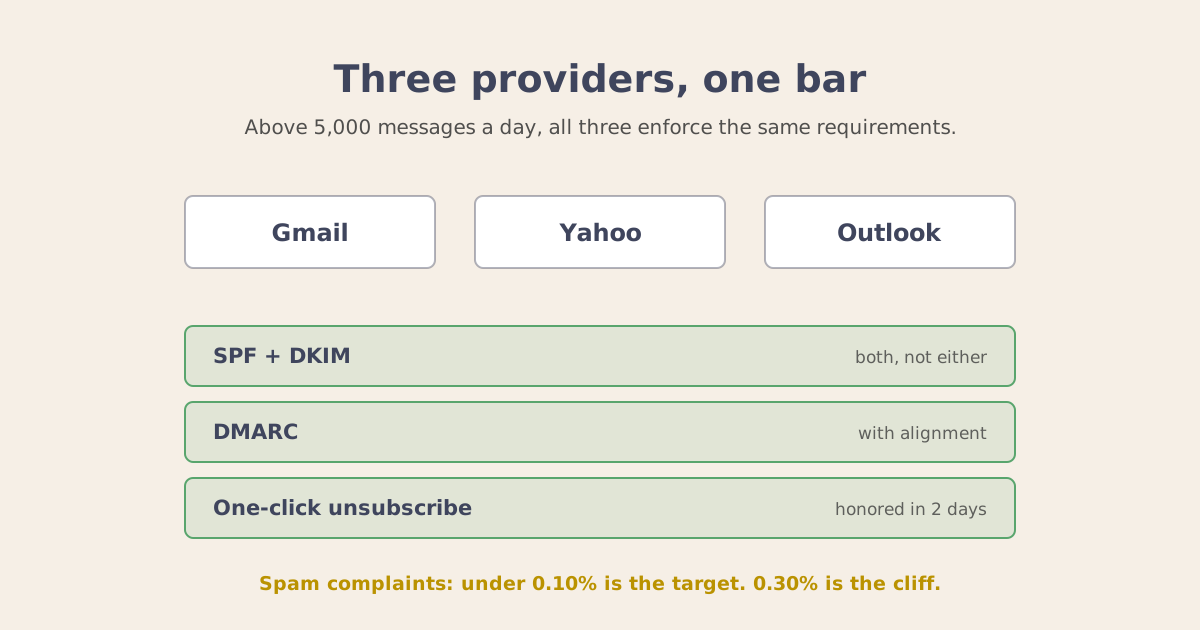
The subject line is a separate discipline. It’s the only part most recipients read, it’s written under a character limit, and it has to intrigue without misleading. Overpromise and you win the open and lose the sender reputation.
Writing Against a Segment, Not an Audience
Writing a good email and knowing who should get it are two different skills. This is where they split.
A general copywriter writes to a persona. An email copywriter writes to a segment, and a segment is a real, queryable group defined by what people actually did. Someone who bought twice in ninety days isn’t the same reader as someone who subscribed eight months ago and has never opened anything.
Sending both the same email is the most common failure I see, and it doesn’t present as a copy problem. It presents as a performance problem. The copy was fine. It was addressed to nobody in particular.
What Changed
Drafting, variants, subject line options, adapting one message across five segments: that work has become fast. Pretending otherwise doesn’t help anyone decide who to hire.
What didn’t get easier is everything upstream of the draft. Knowing what this email is for. Knowing which segment it’s going to and why that segment exists. Knowing where it sits in the lifecycle, what the reader saw last week, and what happens if they don’t respond. Knowing when the honest answer is not to send anything.
That was always the scarce skill. You just couldn’t see it on its own, because producing the copy took long enough that the thinking happened inside the same job. Nobody had to name it separately, so nobody hired for it separately.
They’re separate now. A writer who only produces copy is competing with something that produces copy instantly. A writer who understands lifecycle position and segment logic is doing work that doesn’t commoditize, because a model only knows what it’s been handed. It doesn’t know that the last send underperformed, that this category actually reorders closer to six weeks, or that the warehouse is nearly out of the thing you were about to feature. Someone has to bring all of that to it, and that someone is the hire.
Where the Judgment Actually Comes From
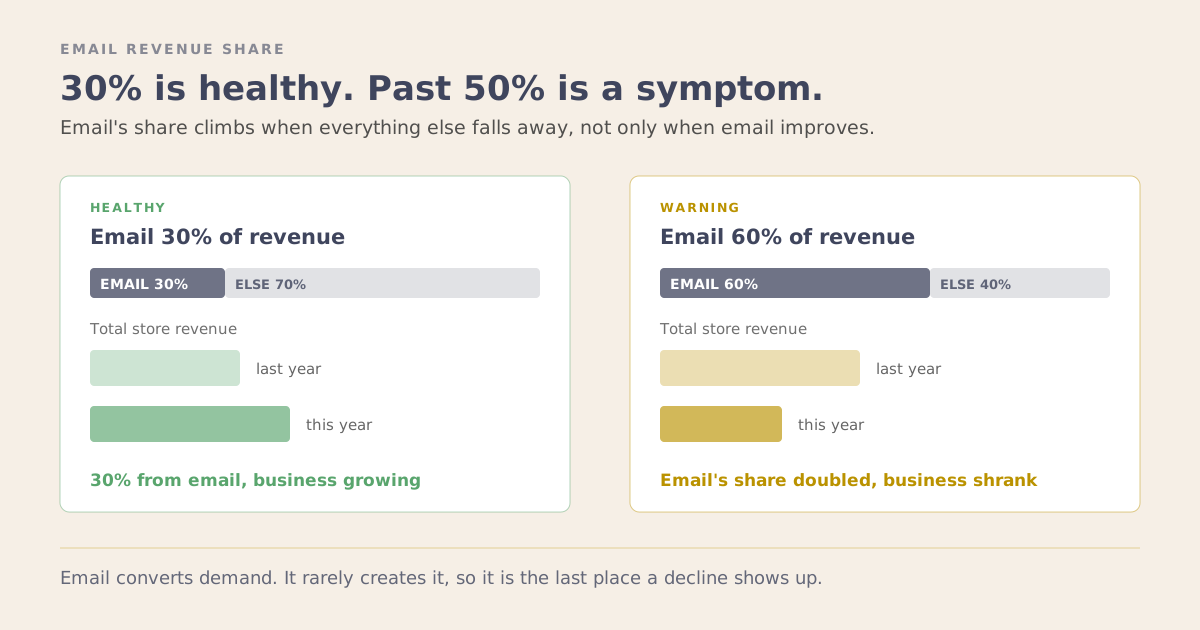
All of which adds up to hire for judgment, which is easy for me to say and close to useless on its own. Judgment about a specific brand has to be grounded in that brand’s data. Otherwise it’s just taste.
This is where connecting the account to an AI layer changes the work rather than decorating it. With Klaviyo connected through MCP, the questions underneath every segment become answerable directly instead of assumed.
Where does repurchase actually stall for this brand? A ninety-day win-back window is a convention, not a finding. Some categories stall at six weeks and some at nine months, and the wrong number fills your win-back audience with people who were never coming back while missing the ones who were.
Which customers belong in a high-value segment? “Top spenders” is the easy query. Realized lifetime value against acquisition cohort is the useful one, and they rarely produce the same list.
What share of a segment has engaged with anything in the last six months? Worth knowing before you write to them, and worth knowing before you count them as an audience at all.
This isn’t hard work. It’s just tedious, and tedious enough that it doesn’t get done, so the generic segment ships and the copy gets blamed.
Then there’s the maintenance problem. Segments drift. A definition that made sense in March describes a different group by September, and nobody notices, because the flow keeps sending and nothing reports an error. A weekly automated check catches that. A person with good intentions doesn’t.
That’s the difference between using AI and having an AI workflow. Asking a model to write five subject lines is the chatbot phase. Having it read the account, define the segment from what’s actually there, and flag when the definition has drifted is the workflow phase. The first saves a writer twenty minutes. The second is what makes the writing point at the right people.
It’s also the same distinction that separates email marketing from retention marketing. Email marketing optimizes a channel. Retention marketing optimizes a customer. Production versus the reason production is aimed anywhere useful.
A Correction: Email Copy and SEO
An earlier version of this post said email copywriters optimize email content for search engines by integrating keywords. That was wrong, and it’s worth correcting in place rather than deleting without a note.
Email bodies aren’t crawled or indexed. Keywords in an email do nothing for search visibility. The inbox isn’t a search surface.
There’s a narrower true version: if you publish emails as web pages, a public archive or a newsletter landing page, those pages are indexable and normal SEO applies. That’s a publishing decision about the archive, not a copywriting decision about the send.
Anyone telling you to write emails for SEO has confused two jobs.
What to Look for Now
If you’re hiring, the brief has changed. Three things worth testing:
- Give them a segment, not a topic. Ask what they would send to customers who bought twice and have gone quiet for sixty days. A production writer asks what the offer is. A retention-minded writer asks what those customers bought and what the normal repurchase interval looks like.
- Ask what they wouldn’t send. Restraint is the clearest signal of judgment. Someone who has never argued against a send hasn’t been responsible for a list.
- Ask them to explain a subject line they rejected. It reveals whether they’re thinking about sender reputation and the next twenty emails, or only the open rate on this one.
The writing is the easy part to assess and the least scarce thing you’re buying. Test the thinking, and give whoever you hire access to the data the thinking depends on.
If you want a second opinion on how your lifecycle and segments are structured before you hire against them, book a strategy session.