Email Marketing vs Retention Marketing: What Actually Changes
Three years ago almost nobody advertised retention marketing. Now it’s on every agency’s home page, mine included. Most of the time the deck changed and the work didn’t, so a brand signs what it thinks is a retention engagement and receives a sending calendar.
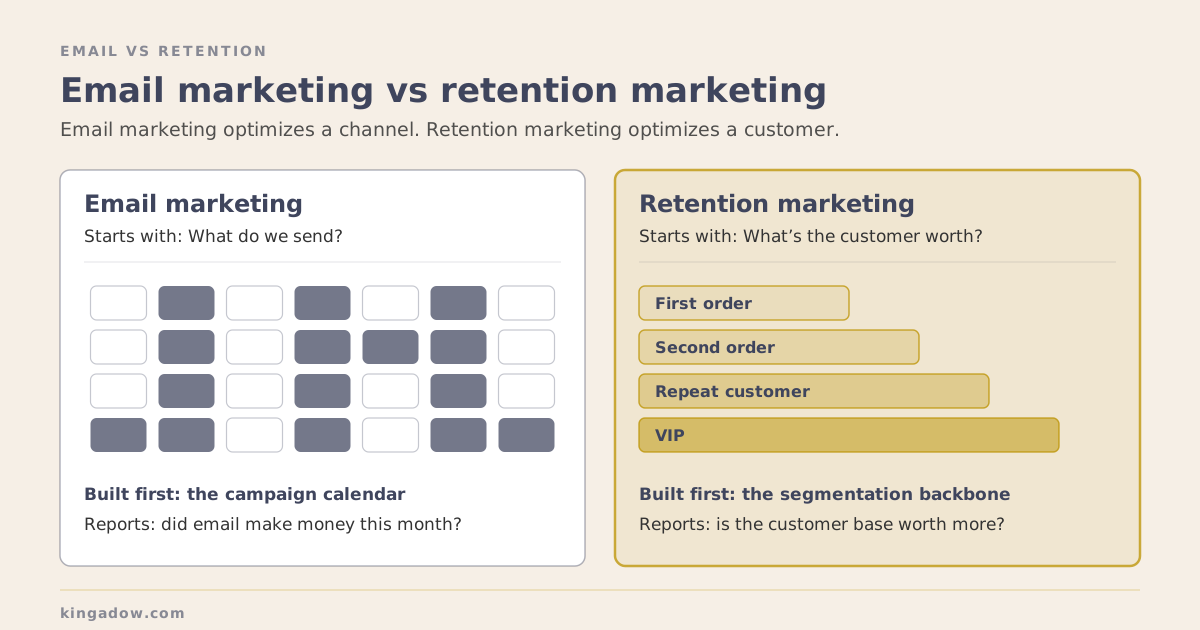
Here’s the difference in one line. Email marketing optimizes a channel. Retention marketing optimizes a customer.
Email marketing asks what to send next. Retention marketing asks what a customer is worth, and what would make them worth more. Every other difference, the diagnosis, the metrics, the deliverables, follows from that one.
This post will help you tell the two apart before you hire an agency for either one.
What Retention Marketing Is
Retention marketing is the practice of growing the value of the customers you already have. Email is one input into that. So is the offer, the reorder timing, the packaging, the support reply, the loyalty program, a subscription where the product suits one, and whether the product arrives the way the customer hoped it would.
Thomas Lalas, who wrote Retention Economics, puts the same point more bluntly: “Email is a channel. Retention is a systematic approach.” I’ll come back to his book later. It’s the best thing I’ve read on retention, with one catch: it’s written for subscription brands.
What Each Engagement Actually Produces
The deliverable lists overlap. That’s why the two are so easy to confuse. The difference shows up in what gets built first, and what gets reported at the end of the month.
| Email marketing | Retention marketing | |
|---|---|---|
| Starting question | What do we send? | What’s the customer worth? |
| Unit of work | A campaign or a flow | A lifecycle stage |
| Diagnosis | Flow audit, list growth, channel revenue | Cohorts, repeat rate, RFM, lifecycle gaps |
| Built first | The campaign calendar | The segmentation backbone |
| Time horizon | This send, this quarter | 6, 12 and 24-month value |
| Failure mode | Sending fatigue | Spending on customers who will never pay it back |
An email engagement starts with the calendar, because the calendar is the product. A retention engagement starts with segmentation, because no flow or campaign is worth building until the account can tell a first-time buyer from a lapsed VIP from someone who only ever buys in December.
The monthly report is the quickest way to tell them apart. Channel reporting answers one question: did email make money this month. Retention reporting answers a different one: is the customer base getting more valuable. Open rates still show up in my retention reports, but only as a health check. They’re never the main number.
The Metrics Change, So The Decisions Change
Here’s how the two ways of measuring lead to different decisions.
Take a flow that earns well. In channel reporting it’s a winner, so nobody touches it. Read it the retention way and you also count what it cost: the unsubscribes, the spam complaints, the people who will now never see anything you send again. Those people were already yours. Some flows spend more of them than the revenue is worth, which makes them a loss recorded as a win.
You can check this yourself. Klaviyo’s flow reports show unsubscribes, spam complaints, revenue per recipient and average order value, so any brand can run the comparison on its own account in an afternoon.
The second change is ranking. Channel thinking ranks flows by size, so the one touching the most people looks most important. Retention thinking ranks by revenue per recipient, and the order comes out differently almost every time. The smallest flow in an account is often the one earning the most per person, and the biggest is often the one costing the list most.
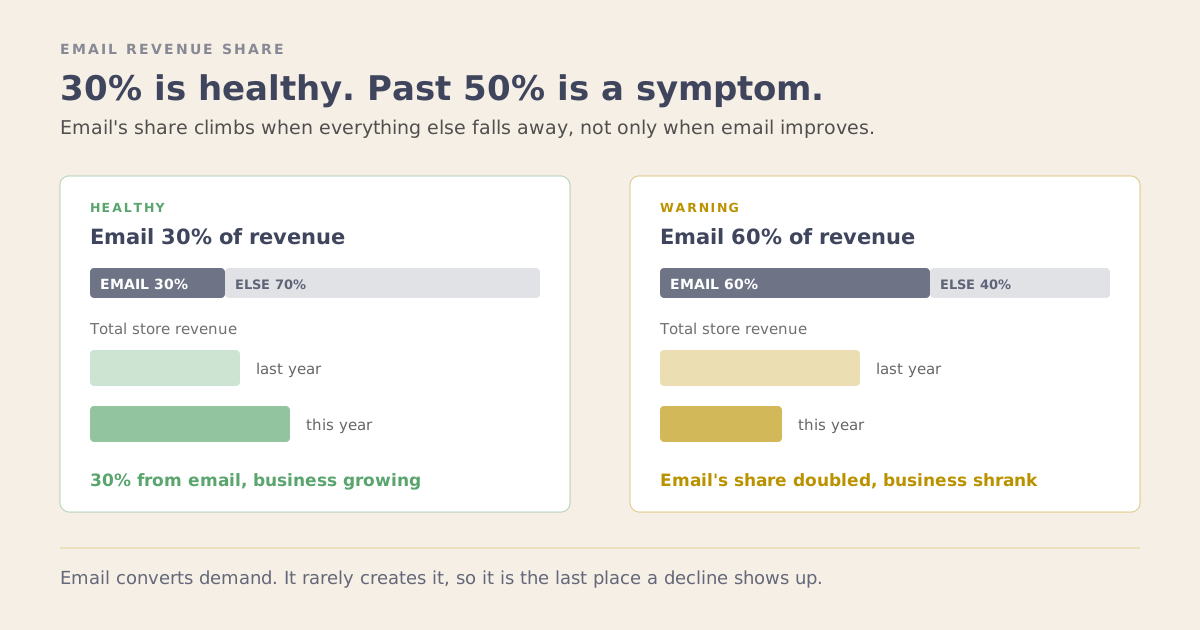
One number deserves care here, because it gets used as a target. Email attribution, the share of revenue credited to email, is worth watching and worth not chasing. A healthy account tends to sit around 30%, and a share climbing past 50% while total revenue stays flat usually means the rest of the business is shrinking rather than that email improved. Lalas is harder on the number than I am. He says the 30% rule has no basis at all. We agree on the thing that matters: it’s a diagnostic, never a goal.
What You’re Signing Up For
The same scope of work, written two ways.
Email framing: flow audit, flow rebuild, email design system, campaign calendar, pop-up strategy, segmentation, list growth, performance reporting.
Retention framing: lifecycle architecture, lifecycle program design, segmentation backbone, channel orchestration, zero-party data strategy, cohort economics and lifetime value reporting.
Plenty of the execution is shared. Both produce flows and campaigns. The difference is what decides which ones get built. In an email engagement, the calendar decides. In a retention engagement, the customer lifecycle decides, and the calendar follows from it.
Retention When Nothing Is On Subscription
Almost everything published about retention assumes a subscription. The benchmarks are subscription benchmarks, the levers are billing levers, and the worked examples are boxes that ship every 30 days.
Most of the brands I work with sell nothing on subscription. Gifts. Apparel. Home goods. Products bought for an occasion, or once a season, or whenever the last one runs out. There’s no cancel event to catch, which is exactly what makes it harder. The customer who’s leaving does nothing at all. They simply never come back, and no screen in the account announces it.
What replaces the billing cycle is the repurchase clock, and non-subscription brands run on three different ones.
Occasion-anchored. Gifting is the clearest case. The second order is often 11 or 12 months after the first, on the same date, for the same person. A 90-day win-back aimed at that customer is noise. The trigger that works is the anniversary of their occasion, which the account already knows and almost nobody uses.
Replenishment. Consumables bought one at a time, with no subscription attached. The right interval comes from the gap between that customer’s own orders, which the order history gives you per product.
Durable. Footwear, furniture, a mattress. The second purchase may be years out or may never come. Retention here means accessories, care, referrals and warranty, and it means investing in the customer tiers that actually repay it rather than nursing a buyer who’s finished.
Two of the engagements I’m proudest of were in this territory, both gift businesses, both rebuilt around RFM and lifetime value rather than a calendar. Neither sold a subscription. Neither had a churn event to intercept. The work was finding the clock each customer was running on.
Which brings me back to the book. Retention Economics by Thomas Lalas is the sharpest treatment of retention economics I’ve read, and I bought it to learn outside my own lane. Read it knowing what it is: it’s written for subscription and CPG brands at 8 and 9 figures, its first growth lever is to go subscription-first, and its benchmarks are subscription benchmarks. If you sell gifts or apparel, take the economics and leave the billing mechanics. The reasoning transfers. The thresholds don’t.
Where The AI Layer Earns Its Place
Every question in this post is answerable from data a brand already has, and almost none of them get answered. When does this customer usually reorder. Which cohort pays back. Which flow is spending the list faster than it earns. The reason is rarely ignorance. It’s that each answer takes an export, a pivot and an afternoon, so it happens once during onboarding and never again.
That’s the gap the workflow layer closes. Connecting Klaviyo to Claude turns those from projects into questions, and scheduling them turns the answers into something that arrives whether or not anyone remembered to ask. The default 90-day win-back gets replaced by the interval this brand’s customers actually run on.
It’s the difference between using AI and having AI workflows. Asking a model for campaign ideas is the first. Having it read the account on a schedule and tell you which flow is costing more than it earns is the second.
How To Tell Which One You’re Being Sold
Four questions, and the answers sort it quickly.
- Do you know our 12-month value by acquisition source? Channel work doesn’t need this number. Retention work can’t start without it.
- What share of revenue comes from repeat customers? If nobody has measured it, the engagement is about sending.
- When you audit a flow, what do you measure? Opens and clicks point one way. Time to next purchase and cohort behavior point the other.
- What’s a customer worth to us? An answer in average order value is a channel answer. An answer in lifetime value is a retention answer.
None of this makes email marketing the lesser choice. Some brands genuinely need the channel fixed: the flows are thin, the calendar is empty, the list is too small to cohort yet. Hiring for a lifecycle architecture at that stage means paying for a system the business can’t feed. Either can be the right choice. The real mistake is paying for one and being handed the other.
If you want to work out which one your brand needs next, here’s how I work with brands.